Author: ImpPossible

May 2016 – Homing Blue Parrot

After 8 months of negotiating with the neighbours and bartering a promotional video with the local oyster farmer to drop concrete blocks for her mooring., Blue Parrot is finally happily home, swinging pretty in JellyFish Bay.

Blue Parrot & Humpty Dumpty

We call her orange egg-shaped mooring buoy Humpty Dumpty because he resembles that nursery rhyme character. Terry decorated him with marvelous marine critters he created from yellow reflective tape which came all the way from China.

Humpty Dumpty bedecked with Sea Critters

We sailed most of the way into our bay from Powell River harbour. It was a lot of downwind wing and wing sailing with some broad and beam reaches. Preventers on the boom saved us from accidental jibes in 8 – 16 knot winds and 1.2m waves that ricocheted off islands and collided with each other, bullying the stern around.

After 7 hours of constant attention and steering to avoid escaped logging debris we glided in to our bay through a tapioca pudding of moon and water jellyfish undulating and pulsing pale lavendar umbrella bodies. It was impossible to avoid them, in fact I’m sure they helped smooth the way for Blue Parrot as we eased her toward Humpty Dumpty and tied up.

If you are curious to catch evocative video of moon jellyfish  in their sensual undulations – like jelly belly dancers – visit Terry’s amphibious adventures and other antics at http://amphibiographer.tv

Jellyfish So Thick You Could Walk Across Them! from Terry L Brown Amphibiographer on Vimeo.

April 2016 – Hydrophones

The NEW portable hydrophone system

Whales are in the news these days. Lots of Youtube videos of resues from fishing gear entanglement. Strandings bring out dozens of humans willing to donate days and nights to heroic rescue efforts. And recordings of Humpback Whalesong are popular.

I have ordered a hydrophone from Cetacean Research Technologies. I had wanted to build a stereo hydrophone so it would be possible to determine the general direction whales were moving. However, the the wife of the engineer who was going to assist me with designing and constructing it suddenly had a medical crisis. Recovery is going to take a while. Since I don’t have the workshop or tools to fabricate an array this single hydrophone will have to do for now. It will be on a 30m cable so I can drop it down into a deep sound channel that whales might be using to transmit their lower frequency, long distance communications. That can only be done when the boat is stationary. Towing one hydrophone is only possible when moving up to 3.5 knots under sail in a breeze under 8 knots. Otherwise the noise of the water flowing over the hydrophone is too loud. It’s a dance to monitor the hydrophone while sailing the boat but we are practicing.

Since the whales seem to be hanging out on the East Coast of Vancouver Island at the moment we are busy patching all the slow leaks in our watercraft. How ironic that all our boats are inflatable! On this jagged rock, barnacled and oyster strewn beach we need a plethora of patches and endless tubes of glue.

One of our inflatable boats.

So, between the patching of boats, resoldering of electronic devices like the depth sounder, installing LED running lights, slathering silicone over everything, checking instruments and searching Youtube videos for How to fix, install or build everything , we haven’t had a lot of time for much else.

Oh, and the carburetor is still leaking even after Tony, our virtuoso mechanic friend, babied it and cleaned it twice. After 9 months of trying to fix it we finally ordered a new one from Moyer Marine in Pennsylvania. It will hopefully arrive in the next 2 weeks.

Meanwhile we are sweating over fund raising proposals to support the project and we are editing short videos.  Also, we just found out that this beautiful log house we rented and spent a year setting up as a live/work space may not be available to us after our lease is up in June 2017. It would be so encouraging if we managed to get out on the ocean to meet some friendly/curious whales.

March 2016 – Where are the Herring?

It’s been quite the month. The month of searching-for-herring. Terry’s article about herring being a key species in the food web ecology of the west coast was published in Powell River Living magazine. It uncovered lots of support in the community for protecting resident herring populations which, according to Federal Deptartment of Fisheries and Oceans, do not exist.

At least they seem to have disappeared quite suddenly from FOC literature after 3 years of intensive seine boat fishing caused a crash in the Salish Sea “stocks”. “Stocks” is commercial fishery jargon for populations of real live beings, in this case herring, who they treat like stocks of inanimate objects. It’s all part of our residual industrial paradigm, that nature does the work for us and humans take whatever we want from a never-ending supply.

Those of us who were so excited by indications that more herring spawned here in the past 2 years than in the past 3 decades eagerly anticipated this year’s spawn. There has always been a huge spawn on the east coast of Vancouver Island. This year commercial seiners immediately invaded South East Vancouver  Island to vacuum out their allotted 8,500 tons of herring eggs. Legally the order of priority for who gets to fish is:

1. First Nations Food & Ceremonial Fishery,

2. Commercial Fishery,

3. Sports Fishery.

However, Fisheries and Oceans Canada is so enmeshed in the mega corporate net of  the Jimmy Pattison Group, holder of 183 of the seine boat mortgages, that priority rights seem to fade into the background. The commercial gill netters rushed to the scene next but by the time they got their turn only half their quota was fulfilled. Tla amin Nation here in Powell River sent a Resolution to FOC stating that:

“1) The Council of Sliammon First Nation opposes the commercial fishery as it will affect the ecosystem     in a manner that disturbs all marine species in the Sliammon traditional territory.

2) If the decision of Fisheries and Oceans Canada is to proceed with the commercial herring fishery, Tla’amin Nation will take steps to restrain the mismanagement of the fishery.”

herrringleapmilkyt
Silver herring swim between a rock and the shore

Terry and Jude supported the resolution and asked the City Council of Powell River to do the same. The City passed a statement of support for the resolution and said they would take the issue to the AVICC Association of Vancouver Island Coastal Communities convention.

The City submitted a motion at AVICC for a moratorium on all coastal herring fisheries until the populations recover, but it was not accepted as a discussion item because it was introduced too late. However, it was listed in the list of current issues facing the coast. A little disappointing considering the relevance to so many coastal communities but it’s a start. We can build on it through the year.

Meanwhile, we have been searching every bay and inlet for herring spawn and shoals of fish. We discovered that there was a herring spawn at the head of our bay! Herring even laid eggs on the bottoms of barrels used to hang lines of oysters from in deep water oyster farming. Clever herring, hiding their eggs from aerial predators. We have been snorkeling, looking for schools of translucent larval herring in the shallower water at the head of the bay. They difficult to see but fascinating. You can see right through their skin to their internal organs – like having Xray eyes.

Why all the excitement about returning herring, you may ask? As nutritious forage fish they support much of the food chain. Everybody from seals to gulls to humpback whales eats them. Recovering numbers of herring may be the reason for humpback whales returning to this area and hanging around to feed. So it is crucial that we humans manage our greed and let the herring populations recover. Good for the birds, good for marine mammals and good for future fisheries too.

Dark herring school over cobbles

February 2016 – Waiting for Herring

Everyone around the Salish Sea is waiting for the herring spawn. This includes the seals, sea lions, water birds, chinook salmon and the 3 humpback whales who have been patrolling between Texada Island, Vancouver Island and the Lund area. Two of those whales are the Mom and calf who have been hanging around our area all winter. sealionsswimwhiskers

The guys who run the local water taxi confided that they became concerned about the calf when they noticed herm (a word invented by Terry to indicate her/him when this is not known) hanging around by hermself without Mom. There are transient “Biggs” killer whale groups hunting marine mammals here and they will go after a humpback calf or even an adult if vulnerable and alone. However, Mom showed up after a few days so all is well for now. It will be interesting to discover how long Mom and calf stay together as the year unfolds. No one can remember a calf overwintering here with herm’s mother. Some are wondering whether herm was actually born in these waters!

THE SHIP

As always we are working on Blue Parrot, preparing for a season of filming on the water. Jude’s old solar panel mat is doing a great job of keeping both batteries charged.

With all the energy saving devices and LED lights now available we could actually get a small fridge that would only draw 4 amps. That’s as much as our current anchor light – incredible! Time to shimmy up the mast and swap out that light for an LED!

Whale Journals – January 2016 – Atomic 4 Energy!

Did I mention the engine?

Sailing is a zen art form – working with the wind, feeling its direction, its strength, its pulse – riding the sea as she rocks and cradles you. Or sends you flying across the deck in wild parody of cradles gone mad. Flung from port to starboard, bracing bow to stern, every muscle in your legs  charlie horses in agony.

Becoming intimate with the elements, reading the sky, full-on stars on a moonless night. Ah the romance, the glamour. But in the pub, over a beer or two, conversation inevitably collapses into consulting about water pumps or electrical wires or some noise in the engine that can’t be identified.

And with a 1972 engine there’s a lot of noises. Like the one that erupted from the engine block after Terry and I installed the carburetor for the 4th time and started it up.

“OMG WHAT WAS THAT????” Both of us jumped for the “kill” switch in horror.

“There’s an asthmatic weasel in there and it’s going POP!” I spluttered still shaken from the horrible clanking cough.
“That’s it. This time it’s a !#$! anchor!” swore Terry.

That was at the end of November. THAT was a sound I never want to hear again. Despondent and discouraged, Terry and I spent the next couple of months looking for other sailboats with skookum engines and more headroom (Terry is 6’4″) that we could afford to buy – none. And figuring out how much money we could get for the Parrot ship with a non-functional engine – none. We were at an impasse.

After New Years we visited the Parrot ship to mull things over.  A few other skippers were puttering around their boats so we got brave and fired up the engine again, asking them to give a listen. The weasel had got over his death rattle cough and was banging around in the engine block with steel-toed boots on. It sounded like a thrown rod to me (who knows worse than nothing)

“Yah, could be” said the skippers.

Advice from the puttering skippers? “Run it till it dies.”

“How long will that be?”

“Could be a year or two”

“OK, but what happens then?  It’s not like we can call a tow truck.”

“Coast Guard is always looking for something to do” offered another skipper.

We desperately needed somebody for a fourth opinion. And I knew just the somebody. Kim, our local sailing club commodore. I asked him if he would take a listen to “The anchor” and tell us whether it really was an engine or just ballast. The generous fellow agreed and arrived at the ship with a meter long piece of 3/8″ dowling which he used like a stethoscope to examine the sound of each cylinder and valve. Of course “The anchor” started up fine for Kim although he still couldn’t get a slow idle. Still, after running it for 20 minutes with varying amounts of throttle he diagnosed the problem as “Sticky valves from not being used.  Seems to be running better now.” At which point “The anchor” stopped dead.

“That’s what happened when we were coming into the harbour last time” said Terry

“Start ‘er up again” said Kim

“chugga chugga chugga chug” said the weasel “chugga chugga chugga chugga chugga….” “chugga chugga chugga” “chugga chugga” …..etc.

“Are you giving it some choke?” Kim yelled

“Yah, it doesn’t start without it” I yelled back

“Don’t” yelled Kim “Maybe we flooded it.”

While we waited for the flood to subside Kim sprayed some WD40 into the cylinders, a tricky job. Choke full out we started “The anchor” again. After 15 minutes of running in neutral, forward and reverse at the dock Kim decided we should take the Parrot ship out of the harbour and motor around to test her under real conditions.

“Wow! we’re out of the harbour. I could enjoy this” Terry was at the helm as Kim, who was half inside the engine compartment, shouted out throttle and gear commands to him through the companionway. Blue Parrot was motoring through the tests. I was smiling. It wasn’t raining and we were motoring along outside the harbour breakwater – when “The anchor” lived up to its name.

“WTF?” said Terry “WTF?” said me.

“Quick! get me some of those oil cloths” yelled Kim. I grabbed a few and peered in the companionway where he was stuffing cloths into the flame arrestor which he’d just pulled off the carburetor and which was drooling pink gas. oh oh.

Kim mopped up the gas  and put the flame arrestor back on the carburetor loosely just in case he had to yank it off again. “OK. Start her up”

“chugga chugga chugga chug” said the weasel “chugga chugga chugga chugga chugga….” You get the picture.

“The anchor” finally started but  a wind was coming up so we opted to take her into an easier part of the harbour  just in case “The anchor” cut out again. Of course it didn’t.

A few days later we prevailed on a friend with a dinghy to accompany us, just in case we needed a tow, as we motored straight back to our slip on a beautiful sunny day perfect for sailing. sigh…..

Back in our slip we were racking our brains about how to configure a mount for a reliable outboard motor. Meanwhile, Terry noticed some interesting configurations on the sailboat in the slip across from the Parrot ship. He struck up a conversation with Tony, the owner of the boat.

Tony is a retired mechanic who moved to Powell River last year. Aside from being a virtuoso mechanic and gardener he designs and engineers his own boat fittings from scraps of wood and metal he saves or salvages. He is also a very good teacher as we found out later. And his brother-in-law has an Atomic 4 engine in his boat that needs rebuilding. So he was very interested in our Atomic “anchor”.

“Can I take a look at it?” Tony asked

“Come in, come in” said the spiders to the fly. (He doesn’t know what he’s getting into we were thinking.)

“Can you start it up?” So we did. “Do you know how to adjust the idle mixture?” he asked

“We’ve tried and tried but it won’t go into the slow idle”. Tony tried but the engine revolutions wouldn’t slow for him either. And of course the carburetor leaked.

“Did you clean it?” asked Tony. “Only 3 or 4 times” we answered.

“These are simple carburetors but very touchy” he advised. “A tiny piece of sediment can clog up the float bowl needle or prevent it from seating. That will cause the carburetor to flood. Let’s take it off and check it out. I’ll get my tools. It’s a cute engine.”

“OK” Terry and I choroused happily. We could hardly believe it. A cute engine? Definitely a different perspective on The anchor.

A few minutes later the carburetor was off and Tony was cleaning it delicately with surgical precision. “See this piece of dirt?” I put on my reading glasses and could barely make it out. “It was in this pickup tube. That could be preventing fuel or air from getting through” he pointed to 2 microscopic idle discharge holes in the tube. “Now let’s try it again”.

We put it back in place, started “anchor” and Tony actually got the slow idle. But it was running a bit rough. How could that be?

“Let’s take a look” said Tony calmly and took off the carburetor yet again (6th time). “See this?” he said pointing to the throttle plate. “It’s just slightly out of adjustment and not quite seating completely” He moved it 1mm, replaced the carburetor and “anchor” fired up right away without being choked. The weasel jumped on his wheel and ran resolutely and rhythmically. The carburetor eased down smoothly into a steady slow idle.

“I don’t believe it Tony. You’re a miracle worker! Can we offer you lunch? A new lease on life? A lifetime of hugs?”

“Because of you we’ve decided to rename the anchor” we told Tony.

“Oh, what are you going to call him?” he asked

“Lazarus” we said. He laughed. “We should do the valves. I’ll show you how to adjust the valve tappet clearances”

It took a couple of hours to get the valves done. “Keep the feeler gauge level and feel as it just starts to get a little bit of resistance when you move it in and out” he instructed.  It would have taken us a week to adjust the clearances and we would have been guessing. Youtube videos can’t give you the “feel” of when something is perfectly adjusted. Nothing like having a personal trainer.

“Let me know when you want to do the points and condenser. I’ll bring my timing light” Terry and I perform copious jumps for joy in our minds YES! YES! Tony, we worship you. After 2 1/2 years of constant frustration we can’t believe our good luck to have his virtuoso assistance.

I am happy to inform you that the weasel is currently doing a sly soft shoe shuffle as Lazarus is purring along. It feels incredible to be able to get out of the harbour with a reliable engine. We’re pulling out instrument manuals and electrical wiring diagrams. Finally we can start on all the other upgrades and minor repairs we’ve wanted to do but couldn’t because of  – Lazarus.

December 2016 #2 – Vans, Whales & Turtles

There are decisions and plans and then there’s weather! We’ve decided to drive to the southern tip of Baja California in February to join our friends Aashima and Roger. Baj California is on the west coast of Mexico. The 1220km long peninsula separates the Sea of Cortes from the Pacific Ocean. It is an amazing place for marine mammals and there are lots of whales. We are hoping to meet some humpback whales who migrate between here and Mexico.

However,  our current vehicle, a 2007 Santa Fe with front wheel drive, won’t carry all the outdoor, underwater and camping gear we’ll need so we look for a small van. We want all wheel drive, be able to sleep in it when necessary and not spend a fortune on fuel. We have been researching Chevy Astro Vans for a while but good ones are hard to come by since they stopped producing Astros in 2005.

And then there are Delicas. Mitsubishi makes them.  The Delica vans are  4 x 4 deisels which is  a bonus. They are also right hand drive vehicles which could be a problem. Canadian law decrees that they have to be at least 15 years old before they can be imported into Canada so dealers have to ensure that they are in good shape. There are a few dealers in BC who buy them at auctions in Japan and import them. We notice a dozen Delicas driving around Powell River and prevail upon some of their owners to let us test drive them. Then we pick their brains about every conceivable aspect of care and feeding of Delicas.

Much thoughtful, fraughtful and why-not-full research later we phone a recommended Delica dealer and arrange to purchase one. “We want to drive it from Powell River to Cabo Pulmo. that’s about 2600km to the south end of the Baja peninsula.” Mardy, our Filipino dealer ponders that information. Then he insists on replacing any major parts that could fail and would be impossible to get in Baja. Into the shop our Delica goes to receive a new alternator, radiator, water pump, shocks, belts of every description and lights to Canadian standards.

We can visit our van now but won’t be able to take him home until January. “If you drive all day don’t drive the van over 95 – 100km for more than a few hours” warns Mardy. “OK” we respond. We name our van ‘Tortuga’ which means ‘turtle’ in Spanish.

Meanwhile we’re hearing stories of humpback whales hanging out with dolphins, hunting with sea lions and generally cavorting around the Powell River harbour, Texada, Harwood and Savary Islands. A friend emails with news of whales off the local Lookout so we head over, determined to sight cetaceans.

First stop is the Tla’amin reserve village [with permission]. No whales immediately offshore but hawk eye Terry spots some small blows far off in the  south.

A commotion of Dolphins!

Our Binoculars allow us to see a commotion of Pacific White-sided Dolphins leaping and traveling fast.

Close by are a couple of our large friends. Sometimes dolphins will play in the wake of whales.

Estimating  distances over the water is a tricky business.  Is that blob a small duck closer to shore or the dorsal fin of a large whale farther away? A good pair of binoculars is invaluable. When the Texada Island ferry passes between us and our cetacean friends we realize that they are at least 15km away. Too far for video but great to see them anyway.

Whale Journals – December 2015 – Netflukes – whale movies

Not much going on in whale world on the water for us these days. I heard reports of 4 or 5 humpbacks hanging out between Vancouver Island and Texada Island but we’ve been quite busy working.

Last month was about books to curl up and hibernate with during the dark days of winter.This month it’s time for cultural celebrations. And what better way to celebrate than by watching films about whales and interspecies communication?

Youtube is full of close encounters between humans and cetaceans, which I love. The excitement of the humans is in their voices. Even adult voices become squeaky as they leap up 2 octaves when confronted by the awesome presence of a 30 tonne whale approaching their boat. It’s a palpable primal reaction.

But there is little to fear. SLOW DOWN, don’t crowd, make sure you know where they are and they know where you are. It’s best if they can hear you so a slow or idling engine is helpful. If they approach you? it is an experience you will never forget and a story you will retell hundreds of times. Maybe you’ll even make a video!

Back to the many wonderful films about whales:

Of course any of the BBC series like “The Blue Planet”, “Planet Earth”, “Life of Mammals”, “Nature’s Great Events” offer state of the art production values and thrilling footage. The “making of” shorts they made of how they got the footage are fascinating too, especially for budding filmmakers.

National Geographic has become quite sensationalist in their approach to nature films since being bought out  by Rupert Murdoch but this is a good one .

“Ocean Voyager” Whale Documentary – The Biggest Sea Creatures || National Geographic 2015

Story of a humpback mother and calf. The video repeats at 51:16

“The Birthplace of the Giants”  in Northwestern Australia – Nat Geo 2015

Some other smaller productions companies produce great ocean nature films too

“The Giants of Rurutu” Humpback Whales of Tahiti: SOUND & VISION/CINEMARINE 2011


The French Godfather of all ocean nature documentaries – Jacques Cousteau made hundreds of films. Find them in Wikipedia and Search for them in Youtube.

The Undersea World of Jacques Cousteau – “Whales” rerecorded 1991

and “The Singing Whale” about Humpback whales rerecorded 1991

The English Godfather of nature films, David Attenborough is still making features for the BBC. Find his filmography on Wikipedia and Search the series “The Blue Planet”, “Planet Earth”, “Life of Mammals”, “Nature’s Great Events” among others on Youtube

Planet Earth about the Oceans

The Life series about mammals includes cetaceans

Nature’s Great Events Series: Everyone feeds on Herring in the Pacific Ocean

and Feast of Sardines off the coast of southern Africa

Civil war in Sri Lanka protected a recovering population of Blue whales

Planet Ocean [UK]- by Yann Arthus-Bertrand & Michael Pitiot                


Habitat of the Orca Killer Whales & Sea Creatures – Feodor Pitcairn Productions Ltd. 2000


Intelligence and Communication in non-human species that may surprise you

And finally, humans who can communicate with other species:

“The Animal Communicator” with Anna Breytenbach and Jon Young by FOSTER BROTHERS FILM PRODUCTIONS for NHU AFRICA

And how it might be possible


International Film Festivals

where you can find amazing nature films that don’t get Hollywood or network distribution.

Blue Ocean Film Festival

Ocean Film Festival

Halifax International Oceans Film Festival

Cuban Ocean Environmental Film Fest

Asia Ocean Film Festival (Hong Kong)

ENJOY!

Whale Journals – November 2015 – Winter's Whale Tales

I’m climbing up to a moss and lichen bluff near the cabin. A flake-barked old fir and battle-scarred arbutus cling to the shattered rock which constitutes the geology of this cliff on the ridge above our bay. During these dark November days this is the only place I can be sure of catching some sun – only in the middle of the day – if there is any sun – which there hasn’t been.

After the thrills of October it’s not going to be much of a month for whale watching. I’m off to Ontario for a few weeks leaving Terry to hold the home front and video the jellyfish invasion of our bay.

It’s a month for whale research though. I’m reading a lot about cetacean communication. There’s a wealth of information from biologists, naturalists, writers –  basically cetacean lovers of all ages and backgrounds. There are books for children too.

I thought it might be useful to list some books with links to the websites of their authors.

In no particular order:

Dolphin Diaries by Denise Hertzing: She wanted to be the “Jane Goodall” of the dolphin world and she is. Diane has been studying the Spotted Dolphins in one shallow bay in the Bahamas. the book chronicles the first 25 years of her work. Lots of information about communication and dolphin society. http://wilddolphinproject.org/

Among Whales by Roger Payne: Inspiring and devastating. The idyllic life of a family living alongside magnificent right whales and the sadistic blood lust of whalers mad with greed. An eye opening expose of the International Whaling Commission. http://www.whale.org/

The Moon by Whalelight by Diane Ackerman: poetic writing informed by Roger Payne’s (‘Among Whales’) research into Humpback whale songs, behaviour and emotions. http://www.dianeackerman.com/

Dolphin Dreamtime, The Art and Science of Interspecies Communication by Jim Nollman: Back in the 1960s, before it became trendy, Jim Nollman was playing music with whales, wolves, wild turkeys and buffalo exploring their cultures and communications. Check out his articles in back issues of Orion magazine.

http://www.interspecies.com/pages/audio%20main%20page.html

Listening to Whales: What the Orcas Have Taught Us by Alexandra Morton:  Alelxandra Morton is a British Columbia hero. Before her campaign to save wild pacific salmon from the diseases brought in by Norwegian fish farms and denied by Canada’s dysfunctional Department of  Fisheries and Oceans she wrote this book about her first loves – Orcas.   http://www.alexandramorton.ca/

Journey of the Pink Dolphins: An Amazon Quest by Sy Montgomery: weaves together ancient myth and modern science to tell the story of one woman’s journeys searching for the elusive “boto” dolphin of the  Amazon River.

http://symontgomery.com/

Among Giants: A Life with Whales by Charles “Flip” Nicklin: “Flip is equal parts photographer, adventurer, self-trained scientist, and raconteur, and Among Giants reflects all those sides, matching breathtaking images to firsthand accounts of their making, and highlighting throughout the importance of conservation and new advances in our understanding of whale behavior.”   from ‘Whale Trust’   http://www.whaletrust.org/

Hawaii’s Humpbacks: Unveiling the Mysteries by Jim Darling (author), Susan W. Barnes (illustrator) and Flip Nicklin (photographer) “ideal for both novice and experienced whale watchers – answers all of your questions and tells you exactly what researchers know and have yet to learn about the humpbacks that gather annually on the Hawaiian breeding grounds.” from ‘Whale Trust’

Mind in the waters: A book to celebrate the consciousness of whales and dolphins by Joana McIntyre Varawa: fascinating comparison of human motor controls, which are in varied areas of our brains, with cetacean motor controls, which overlap  and apparently cross-stimulate in their brains. We can only imagine how whales and dolphins perceive the world! A collection of science and intuition which appeals to the imagination and heart as well as the scientific mind.

The Delicate Art of Whale Watching: by Joana McIntyre Varawa: “swimming with porpoises, fishing, learning to hunt with bow and arrow; a quiet quest for harmony with nature, especially with the sea”

The Whale Rider by Ihimaera Witi: a wonderful coming of age and rescuing whales story for adults and children. The movie is a must-see too.

 Whale Nation by Heathcote Williams: a coffee table book of historical photos that will amaze along with excerpts and quotes about whales and whaling. From Aristotle to Carl Sagan and Herman Melville to Edmund Burke, scientists, writers and activists like Paul Watson weigh in on whales.

Eye of the Whale: Epic Passage From Baja To Siberia by Dick Russell:  a combination of science, history and travel writing about gray whales and how their relationship with humans  transformed from “devil fish” to family friendly. Lots of historical information.

Eye of the Whale: there are at least 5 more books with this title. Obviously looking into the eye of a whale does something profound to a human being.

So does reading about it. Try it.


Whale Now! 2 – October 2015

BlowDorsalTerry, Jamie and I are perched together on rocks as far out as we can get at low tide waiting for the whales to come around to our side of the inlet. Jamie, who knows their routine, is sure they will make their usual circle and cruise by our campsite. It is dusk already. We can see 2 or 3 whales out in the middle of the inlet. Some of the resident sea lions seem to be playing around them but the light is fading.

These dark cloudy nights aren’t the best for transcendent visions of whales breaching in the moonlight. We can’t conjure a 3D CGI humpback bursting from the ocean in fountains of phosphorescence like the scene in “Life of Pi”. So I sit on the rocks in the light drizzle and wait, one arm extending an umbrella over the microphone I’ve wedged between rocks, the other arm draped in mic cable, listening to the waves in my headphones.

Now! Out of the blackness, Pooooooocccchhhhhh! tyuuuuuuuuuuuuUUUUUUUuuuuuu! Through headphones the sound is electrifying!  The whales could be almost on top of me! Thrills shoot up my back and hairs shoot out my neck. I’ve been plugged into a live electric socket. Their outbreath is a gale-force gust  and their inbreath bugles like a herd of bull elk. They aren’t even singing, just breathing and the music is awesome. We sit erect, enthralled by oceans of whale breath across eons of time. The whole universe is whales.

Sound of whale blow and “bugle” inbreath. Increase ||||||| for more volume

The next morning we are in citizen science mode.  Who are the whales we are seeing and hearing? As many as five humpbacks have been feeding and frolicking in the waters between Vancouver Island and the Sunshine Coast. It would be useful to researchers if we could identify them. The best way to do this is to photograph their tail flukes.

WhaleTail1

Tail fluke patterns  are unique to every individual whale, like human fingerprints. There is a catalog of tail fluke photos that researchers have been compiling for decades. If we can get clear enough photos to identify the whales we are seeing we can find them in the catalog. This is easier said than done. Tails don’t pose for photos before disappearing after a diving whale body.

KelpCreatureTail2Being positioned at a good angle while close enough to capture detail is a challenge. However, if we can identify our whales, we might be able to find them again at their southern migration points in Mexico, Hawaii or even Japan.

Blissful visions of snorkeling in warm, clear waters surrounded by relaxed mother humpbacks with curious calves while upside down males saturate the water with reverberating song  temporarily transport me. I forget the cold rain dribbling down my neck and dream of tropical whale paradises.

There has been exciting news: a Mom and a calf have been in the area. A friend who was fishing while drifting in his little runabout, had to bang on its gunwhales to ensure the Mom and calf noticed he was there when they surfaced right beside him. 

We are sending out psychic invitations to the whales to come around and visit us when we spot 2 whales heading up our side of the inlet. They aren’t wasting any time so we launch our 9ft. inflatable, row out from shore, and drift. Here they come! passing about 30m in front of us. I hold the dinghy in a good position while Terry wrestles the camera from the dry bag. He manages to  capture some video as they cruise past.

It’s a good day.


Whale Now! – October 2015

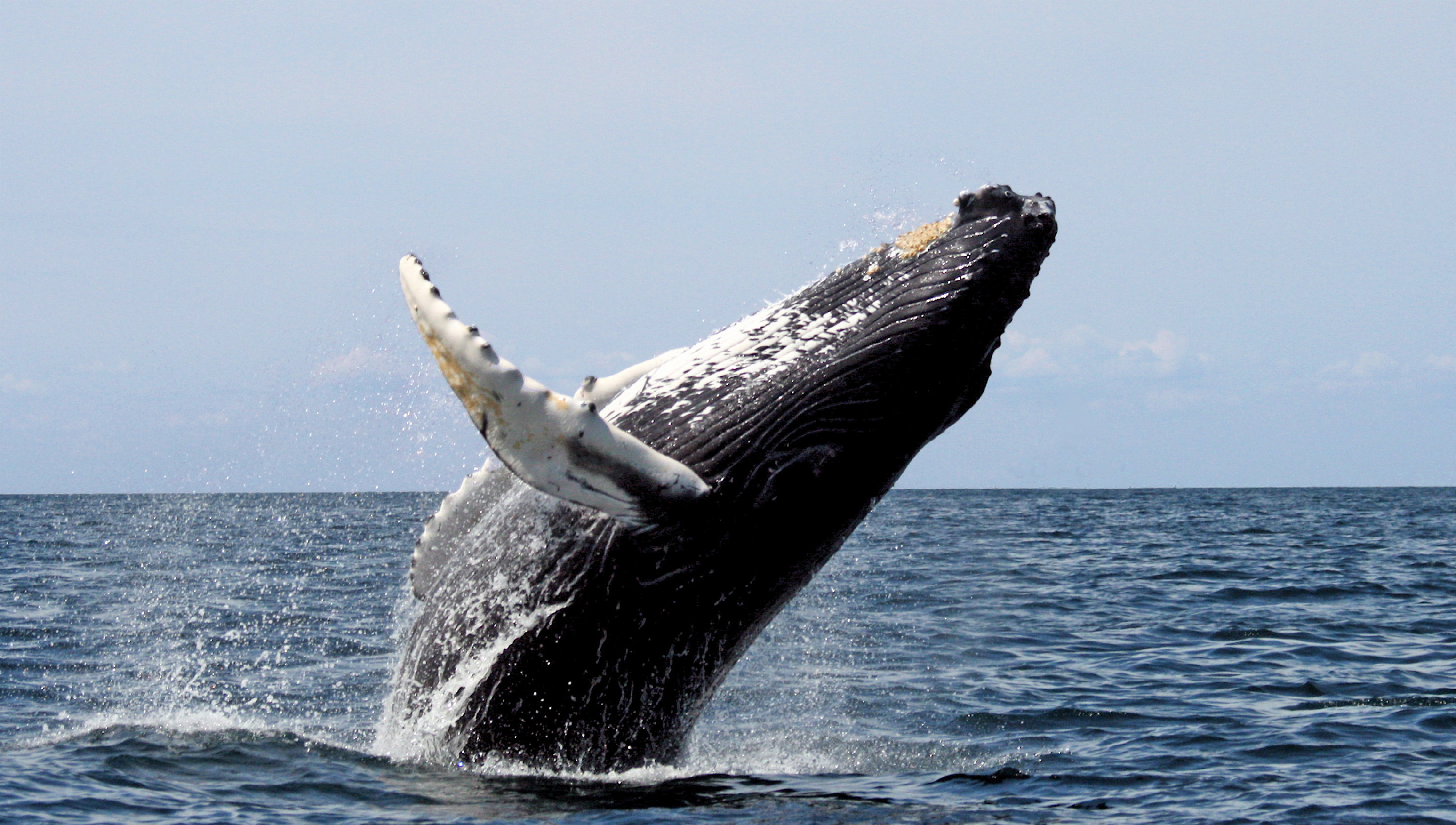
Celebration Time!! Whales! Two of them breaching

Photo of Breaching Humpback By Whit Welles

and tail lobbing on the other side of the inlet! Barking rifle shots of sound shoot across the water when their bodies crash down in cascades of spray. I can hear the guys who are working uphill from our campsite explode into shouts of exhilaration every time a humpback hits the ocean. Truly awesome beings.

What are they doing over there? Are they playing? shedding barnacle larvae off their sensitive skin? stunning a shoal of fish for dinner? They don’t look as if they are feeding. We watch as they disappear further into the inlet and wish they’d come our way.

But we are so lucky to be camping on the shores of Jervis Inlet. It has been quite discouraging not being able to get out in our sailboat to meet whales this year. So when Jamie’s phone call came through from Jervis Inlet our ears perked. Jamie is a wizard with wood who is living in his trailer at the local marina while rebuilding two abandoned plywood trimarans.

“Hey you two,” he greeted us nonchalantly, “there’s whales down here. They’re breaching and breathing and making trumpet sounds.” We were out the door with a tent and our camera and sound gear as soon as we could cram it all into “Goldish” our much smaller replacement for beloved Beluga.

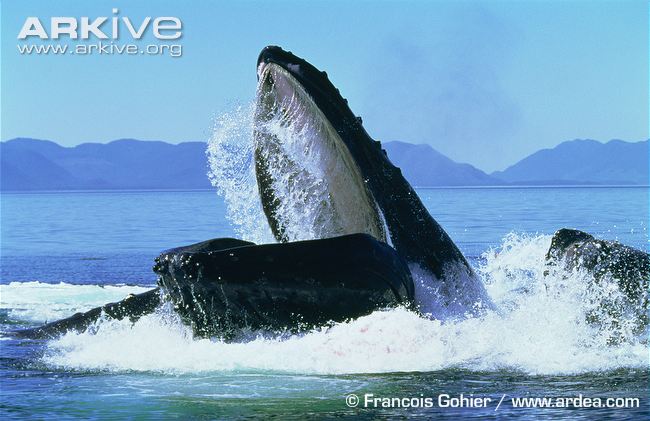
Jervis Inlet is a very deep body of water: maximum depth 732 metres (2,402 ft), perfect for the large clouds of krill (tiny shrimp) that humpback whales love to engulf in their cavernous mouths. Humpbacks are rorquals like blue, fin, sei and Bryde’s whales. Flexible fibrous plates, looking something like vertical combs grow from their upper jaws.

Photo of Open Mouth Humpback by Francois Gohier

The plates, called baleen, consist of tightly packed fibres which fray at the ends into thick, brush-like hair. Baleen grows as long as 0.91m (3 ft ). A humpback can swallow gargantuan mouthfuls of ocean water containing the small fish and krill they relish. Then they use their tongue (about the size of a Volkswagon Beetle)  to sieve the water out through the baleen leaving dinner trapped in the hairs.

If you are sailing or motoring in waters where whales feed, are you terrified about your boat disappearing down the gullet of a lunge feeding whale? Jonah aside, there are no known incidents of whales accidentally swallowing humans. But you may be relieved to learn that the opening at the back of a humpback’s throat is only the size of a grapefruit, rather too small for passing a human.